
Follow us Now on Telegram ! Get daily 10 - 12 Interesting Updates. Join our Telegram Channel https://t.me/OhWomen
Download Telegram App before Joining the Channel
Vashishthasana is a powerful yoga pose that enhances physical strength and mental concentration. It is not merely a side-plank exercise but a pathway to achieving inner balance by challenging one's limits.
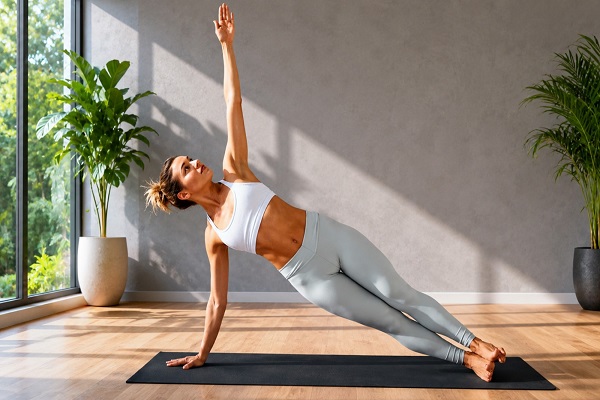
The name Vashishthasana is derived from two Sanskrit words: 'Vashishtha,' meaning 'excellent' or 'supreme,' and 'Asana,' meaning 'seat' or 'body posture.' In English, it is known as the Side Plank Pose. While performing this asana, the body's weight is balanced on one hand and the outer edge of one foot. The body forms a straight, diagonal line from head to heel; the other arm is extended straight upwards, and the gaze is directed toward the raised hand. This pose fosters balance, stability, and concentration within the body.
The Ministry of AYUSH has also highlighted the importance of this asana. According to them, Vashishthasana (Side Plank) is a key yoga pose for enhancing balance and physical strength. It is highly effective for improving body balance and concentration, as well as strengthening the spine. Regular practice of this pose improves body posture—whether walking, standing, or sitting in a chair for extended periods—and enhances overall balance.
To perform this asana, begin by sitting on the floor with both legs extended straight out in front of you. Place your palms on the floor near your hips. Gradually shift your entire body weight onto your right palm and the outer edge of your right foot. Next, stack your left leg directly over your right leg (so that the legs rest one atop the other). Place your left hand on your waist and, using the firm support of your right arm, lift your body upwards. While inhaling deeply, extend your left arm straight up towards the sky. Turn your neck upwards and gaze at the fingers of your left hand. Your body should form a straight line in this position. Hold this pose for a few seconds while breathing normally. After this, slowly exhale and return to the normal position.
Avoid this asana if you have a severe injury or pain in your wrist, elbow, or shoulder.
Source :- IANS